 Coming to terms with my own childhood these past few years has meant re-remembering not just what I did in fifteen years at Church of Flow, but the position I did it from. And this post is the one where that positioning matters most. I want to be upfront about my own vantage point before I say anything else, and I’d welcome you pushing back on any of it, because this is genuinely still unsettled territory for me.
Three words keep turning up in my reading lately, sometimes treated as synonyms: postcolonial mission, indigenous mission, contextual mission. I don’t think they’re the same thing, and perhaps nowhere do they pull against each other harder than in Britain right now.
I want to introduce them here as what I am: a white, Western, emerging church practitioner watching these conversations from the edge of them rather than the centre. That position shapes what I can see and what I can’t, and re-remembering (including coming to terms with the colonising nature of vey word mission) has been one of the more uncomfortable parts of writing this series.
Harvey Kwiyani names an important distinction, the difference between hospitality and mutuality. Most churches are genuinely good at welcome: they value the gifts diaspora Christians bring, are glad of the music and the energy. But welcome still leaves the host in control. There’s a place for you at our table, while quietly retaining the right to decide who sits where, what’s served, and when the conversation ends. Mutuality asks something harder: whether leadership actually changes hands, whether diaspora theology is allowed to unsettle a church’s categories rather than simply decorate them.
because of Mountain Pilgrims Ive ben reading around indigenous theology for a a while now, seeking to learn more the earthed ways of connecting many have lost in the west. Many people say the work I do is uk indigenous mission but I am not comfortable with that term, as it’s not mine to claim. The Centre for Missionaries from the Majority World describes its work as serving diaspora Christians and, in their own words, indigenous white British Christians. If indigenous can mean white Anglicans in Wolverhampton one week and Cherokee elders in Oklahoma the next, it isn’t describing one stable thing. It’s describing a claim to belonging, made differently, by different people, in different power relationships. Randy Woodley and the scholars gathered around NAIITS use the indigenous word for something I have no right to borrow for my own practice, however much the word might flatter it: for Woodley it’s a specific relationship to land, colonisation and ancestry. So whilst others (including some indigenous tribal leaders) might call the church of flow indigenous mission, I dont think it is helpful as skater kids in Somerset, whatever else they carry, don’t share enough with the First Nations communities for it to be appropriate. But there is still much to learn. at recent Mountain Pilgrims gathering a friend explained how she was at a gathering where people were as to introduce themselves and explain who were their people. Something many white people in the room found difficult. My journey of the last few years means I delved deep into my peoples history and probably because I come from a farming family feel a deep affinity with the land and place where ever I am. This I think has been part of what has set me up well for contextual mission and emerging church as the tradition I actually stand in, but it isn’t innocent either. It can hide consumerism, church as another product tailored to a niche market, unless it keeps asking who holds the pen in the story being written.
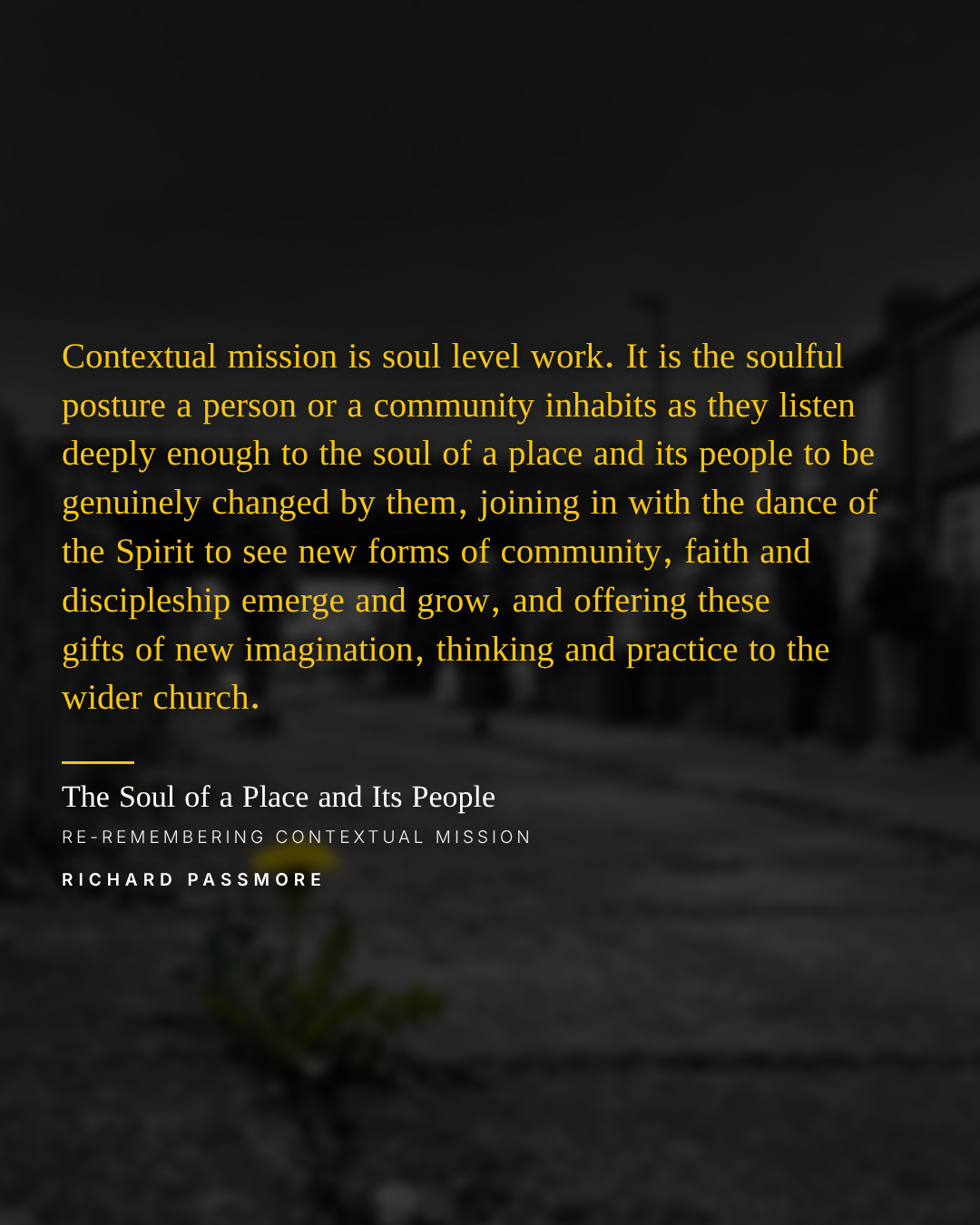
The definition I have been working on for contextual mission is about the posture we hold as we meet soul to soul with people and place. The start point for this has to be understanding where you are coming from. Beyond the ACE stuff I have mentioned and perhaps because of it for me that’s about being a person who crosses spaces and perhaps because the origin of my name is a person passing or crosses Seas and then Moors. So I wrestle from this space and If you stand in a tradition too, I’d be glad to hear how you’ve wrestled with around the term mission what it can or can’t see about itself.