To places we have never been before

Paul Bradbury’s recent reflection on moving beyond empire reminds us how deeply Western mission has been entangled with universalising instincts, the drive to export methods, models, or mindsets far beyond where they first belonged. His question, “How might we save the world without conquering it?” pushes us toward a more humble, localised, and participatory understanding of mission. It’s a call that echoes strongly with what I argued in my previous post what works, works because it is contextual.

If empire seeks control of space, then contextual mission seeks communion IN space. In other words, mission faithful to the gospel begins not with scale but with soil. It roots itself in place but years of contextual mission,following the missio dei and the incarnation has taught us place needs to be understood broadly. Contextually shaped mission is about both “communities of place” and “communities of interest”, and in both these, space matters or perhaps more precisely the space between matters.

Space as the Ground of Context

For communities of place, context is pretty straight forward it’s bounded by postcodes, pavements, local histories, and particular faces. Here, “listening to context” means walking the streets, dwelling among, noticing the patterns of belonging and exclusion, paying attention to how the Spirit stirs through daily life. The missional question is spatial: How is God already at work here?

But the same is true for communities of interest those gathered by vocation, affinity, digital connection, or shared passion. These are not disembodied spaces; they are differently embodied. They occupy networked space, an online forum, a workplace, a music scene, a shared narrative world. These spaces, too, have boundaries, cultures, and ecologies of meaning that also require listening, care, and presence.

To be contextual here means learning the topography of these less tangible places the rituals that shape belonging, the language that signals trust, the injustices and hopes that animate people. This too is place work. Contextual mission is not about being “place-based” versus “network-based”; it is about recognising that space and particularly the space in between is the texture of all context.

The Space Between: From Ownership to Participation

Empire’s imagination is to fill space to occupy, to own, to organise territory. Contextual imagination leaves space, space for others to speak, for grace to emerge, for co-creation. This is not the space of empire, this is the space of incarnation: God dwelling, not dominating; participating, not possessing. 

In our current moment, where both geography and culture feel unsettled, perhaps the task is not to create new models of church or even parish, but to nurture new ecologies of space, perhaps even Brave Spaces of Community and Conversation, porous enough to hold the complexity of both rooted neighbourhoods and fluid networks of meaning.

Context is not an afterthought, It isthe space where the gospel takes shape. So maybe the better question isn’t simply “What works?” but “Where does mission dwell?” Because where mission dwells, (whether a community of place or interest)  determines how God’s story is spoken and heard, and when we listen and join in we go to a new place we have been before. 

Why What Works, Works: Contextual Mission and the Shape of Faithful Innovation

We know, at least intuitively, that some things work in mission and some don’t. We can point to Bubble Church, Messy Church, particular church plants, fresh expressions that have taken root and borne fruit. The temptation is to move too quickly from that observation to replication: this works, therefore let’s do more of it. But that instinct, while understandable, misses the deeper truth. What works, works because at its heart is contextual mission.

The truth is to be effective it has to be about contextual mission. A basic understanding of systems evens backs this up for Worship First church planting models.  This is something I have reflected on before using the Cynefin framework. In the bottom right-hand corner of Cynefin, the simple domain, we are dealing with contexts where cause and effect can readily understood, so worship first large scale plants can work, because you know the soil (context) they need to be planted in. Ie Resource Churches is areas with high student numbers, where the employees suit the context.  You cannot impose a solution from elsewhere and expect predictable results in the Complicated Zone, here you need contextual adaption eg worship first church plants in a market town may need a families worker instead of a student worker.  Then in the Complex and Chaotic Zones context comes even more to the fore, you probe, sense, and respond. You listen. You pay attention. You act humbly and experimentally and so Listening or Community Church planting, at its best, lives precisely here. 

This all works not because any of it follows a universal template, but because it all begins with a level contextual awareness. The plant knows where it is, who it is among, and what the Spirit might already be doing there. That attentiveness to context is not incidental; it is the very reason fruitfulness becomes possible.

At the heart of the things that work in mission is not a model but a posture: listening to the Missio Dei and the context. 

Take Bubble Church as an example. One could argue quite clearly that Bubble Church works because it is contextual mission. It is not magic, nor is it universally transferable. It works because local vicars and clergy have listened carefully to their context, often noticing young families on the fringes of church life, parents seeking connection, children needing space to be themselves, and have identified Bubble Church as a resource that fits. The model is then brought in not as a franchise, but as a contextual response. The same can be said of Messy Church. Its effectiveness lies not in crayons and craft tables per se, but in the way it emerged from listening: to families, to patterns of time poverty, to the desire for intergenerational belonging that does not rely on cultural fluency with inherited church. Messy Church is context-first mission that happened to crystallise into a recognisable form.

Even in church planting circles that talk about being “worship first,” the same dynamic is at play, whether or not it is always acknowledged. Worship-first plants do not appear randomly (or if they do they tend to fail). They are often planted into areas with high student populations, or significant numbers of young adults, or cultures where music and gathering carry particular social weight. The decision to centre worship is might itself be more the result of contextual listening than many assume. 

This is why fresh expressions remain so important. Fresh expressions are not primarily about novelty, nor about ecclesial experimentation for its own sake. They are about starting with context. They are about taking seriously the conviction that there is no such thing as a generic mission field, and therefore no such thing as a one-size-fits-all church.

I have argued that mission takes place within complex, adaptive systems, that culture is semiotic. Therefore, Churches, neighbourhoods, cultures, and networks are not machines to be engineered but living systems to be engaged. Within that framing, More recently I have suggested that faithful mission involves thinking carefully about how we scale: not just out, but deep and up as well.

Scaling out: replicating a model in new places, can be fruitful, but only when accompanied by contextual discernment. Scaling deep is about embedding practices, values, and theological depth within a particular place, allowing mission to become part of the local ecology rather than an imported programme. Scaling up involves influencing wider systems, structures, and cultures, enabling learning and resources to flow without flattening difference.

The common thread running through all of this is about taking context seriously. The danger comes when we adopt a consumerist logic: identifying a successful model and attempting to roll it out indiscriminately. Scaling Bubble Church simply because Bubble Church “works” risks misunderstanding why it worked in the first place. Without the right context, without listening, without local ownership, the model becomes hollow. It may look right, but it will lack life and longevity. 

At the heart of all good mission is context. Not context as a box to be ticked in a planning document, but context as a theological commitment: the belief that God has taken the particular (be that place or interest) seriously enough to become incarnate, and therefore we must do the same. Contextual mission is not a strategy; it is a way of seeing.

If we want to be faithful rather than fashionable, fruitful rather than frantic, then the task before us is not to find the next thing that works and copy it. It is to cultivate communities that know how to listen to God, to place, to people and have the courage to respond in ways that may look very different from one context to another. That, ultimately, is why what works, works.

The changing face of trickster in systems change

Sunday Papers turned 21 last month and so I thought I would look back through some of the themes that have emerged over the years and the 950 or so blogposts. The figure of the trickster has been a restless but pretty constant companion, sometimes provocateur, sometimes guide, sometimes the shadow in the corner when certainty threatens to harden. Journeying back through the archive, I notice how my use of “trickster” has itself been tricky: adapting, morphing, much as the trickster does, to the movements and moods of the times and the evolving questions of church, systems, and cultural renewal. Gathering these together we can see her different guises and learn a few lessons along the way. 

Trickster as Disruption: Stirring the Comfortable

In the early days, trickster arrived in my writing as disturbance. Rooted in the stories of Hyde and the many mythic mischief makers, trickster embodied the kind of holy mischief needed to unsettle our ecclesial complacency. I wrote about the discomfort, border-walking, question-posing, edge-dwelling that trickster brings to stagnant communities. Trickster was the strange guest, misunderstood and sometimes unwelcome, who moved the conversation from comfort to confrontation (which probably also reflects my life stage at the time).

There is a necessary place for this sort of energy in organisations and systems facing calcification, when the status quo is defended with greater force than the call of the gospel or the pulse of life. In this stage, trickster is a mirror to stuckness and a living question mark for institutional “wisdom.” Trickster’s value here is not so much in having answers, but in disrupting, and simply tearing open space for something unexpected to begin.

Trickster as Emergence: The Playful Edge of Creativity

As time went on, my engagement with emergence deepened. Trickster moved from being merely an irritant to something generative, a figure not only to challenge boundaries, but to create new ones, or dissolve them long enough for new forms to emerge. The conversations about “emergent church” and “grace spaces” that led to Here Be Dragons revealed the need to dwell not just at the border, but also in the middle, where the boundaries blur and creation teems.

Here, trickster’s play becomes vital. The themes shifted: less about simply sabotaging structure, more about risking improvisation, learning from ambiguity, and allowing the uncomfortable laughter that comes when certainty recedes. Surprisingly, trickster’s lessons in play, parody, and improvisation offered a source of hope and resilience, essential for organisations learning to let go of the need for control and to make space for emergence.

Trickster as Companion: Deep Listening and Systemic Renewal

In more recent years, a subtler, deeper trickster has come to the fore. No longer relegated only to the borders or eruptions of crisis, this trickster appears as a companion in the slow, ongoing renewals of system and spirit. I found myself drawing on trickster stories not just for their disruptive potential, but as a wisdom tradition for co-creative leadership, deep listening, and navigating unpredictable terrain.

Now, trickster is invoked to remind leaders and communities that true transformation happens in liminal space, between the old and not-yet, in stories shared, questions asked, and boundaries re-imagined. The work is less about subversion for its own sake and more about fostering an adaptive, generative ecology where fresh forms of church and meaning can be discovered. Trickster joins the circle as both risk and companion: an invitation to stay open, responsive, and alive to the wild grace of emergence.

Using Trickster in Organisational Change: Practical Insights

Looking back, I see that the trickster’s role shifts with the system’s need:

• When a community is stuck or stagnant, trickster shakes the ground, challenging, exposing, disrupting.

• In seasons of uncertainty or growth, trickster invites play, risk, and improvisational imagination needed for the new to emerge.

• As change matures and practice deepens, trickster becomes a reminder to listen to what emerges with humility, to hold structures lightly, and to let stories and edges lead the way toward renewal.

In organisational and systemic change, then, trickster is not a one-off tool but a shape-shifter morphing between clown, sage, and the voice that asks the question no one else dares name. The journey through these stages is itself trickster-like a reminder that creative transformation is rarely linear, often surprising, and always a bit mischievous. So I think we let trickster take us further, rooting practice in tricksteresque space where the grace of emergence calls leaders and communities not just to survive disruption, but to welcome it as the soil in which new worlds may be planted. And in this, perhaps, the trickster makes our world anew, again and again.


As part of Alchemy At The Edge I’m thinking of developing three webinars based on these three trickster stages. If you are interested in this please leave me a comment or email me richard@alchemyedge.co.uk 

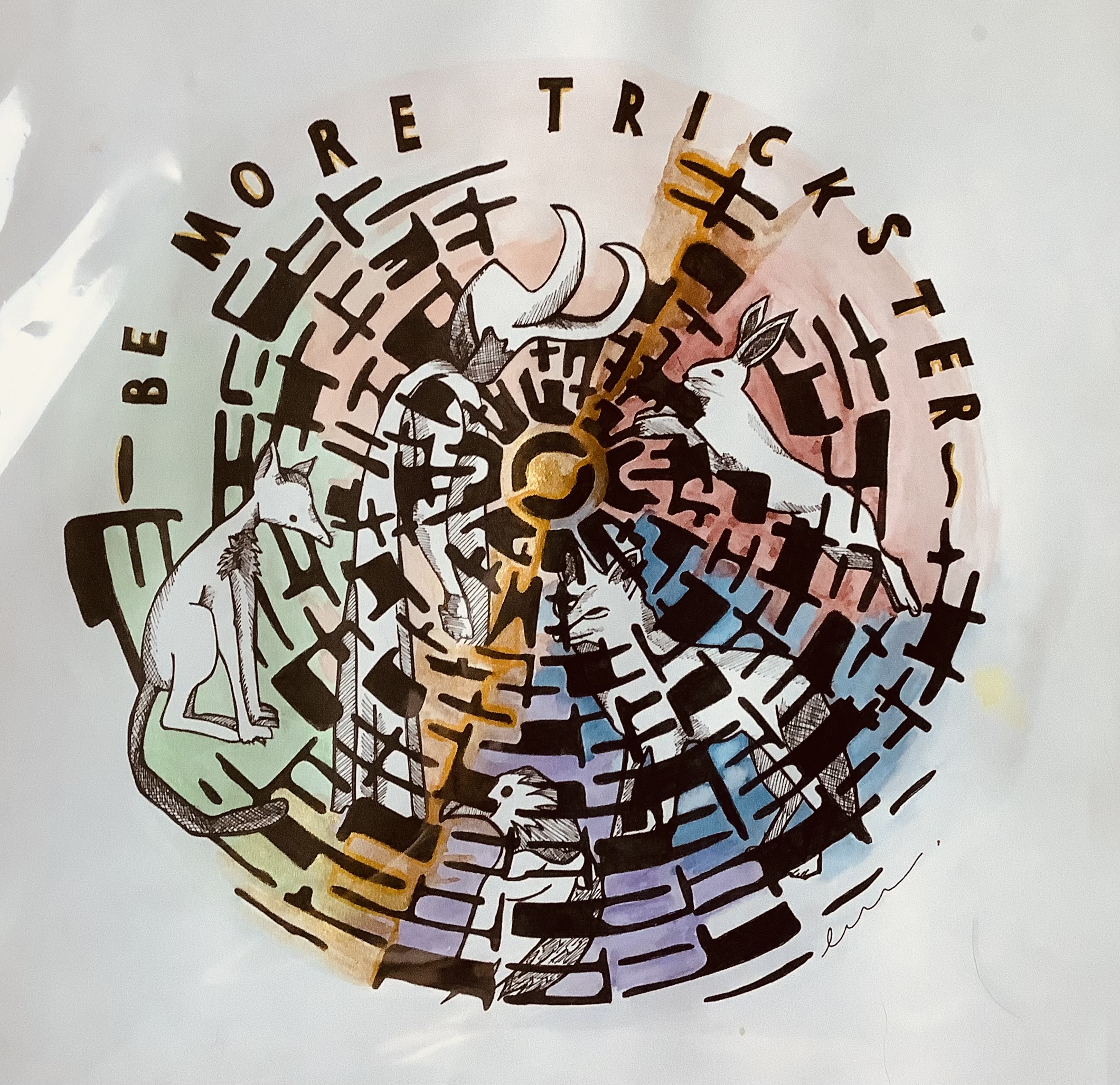
(The image was my leaving present from the wonderful Emma Richardson.) 

Beyond Blueprints: How Systems Thinking Can Transform Mission

We are intertwined systems, they shape us and  we, in turn, shape them. In the years I been blogging here I have  long explored the tangled roots of mission, church, and community, resisting the urge to slip into tidy dualisms or easy binaries. Instead, I’ve tried to inhabit that compost-rich space where culture and nature, activism and contemplation, all intermingle. As I look to the next chapter I want to reflect on that  learning particularly from the “Crafting Mission in Systems” journey and see how they are resonating with the work of Alchemy At The Edge. Skip to the bottom of the post if you want to see 3 services that people are finding particularly helpful at the moment.

From Compost to Craft: Mission as Alchemy

Mission is not a static program to be rolled out, an ABC or a rock-solid truth to be defended. It’s a living, breathing system, a field of relationships, stories, and experiments. We are not outside the system, tinkering with its gears; we are the system. As Bayo Akomolafe says, “we are not stuck in traffic, we are the traffic”.

Alchemy At The Edge, in its very name, hopes to evoke the ancient art of transformation. Alchemy was always more than a quest to turn lead into gold; it was a way of seeing, a practice of attending to the hidden processes that bring about change, both in matter and in the soul. The alchemist’s work was slow, patient, and deeply attentive to the interplay of elements. In the same way, I hope my services are about facilitating transformation within organisations, teams, and individuals, not by imposing a blueprint, but by cultivating the conditions for emergence and growth.

Letting Go of Control: Embracing the Unknown

One of the persistent themes in Sunday Papers is the tension between epistemology (knowing, controlling, securing) and ontology (being, becoming, risking). In the “Crafting Mission in Systems” post, we are reminded that real change rarely comes from clinging to certainty. Instead, it emerges when we risk stepping into the unknown, when we allow “grace spaces” to disrupt our routines and invite us into new patterns of relationship.

Alchemy At The Edge’s approach will mirror this and are be not about delivering off-the-shelf solutions or quick fixes. Recently I worked with a diocese and the planning and preparation sessions with the leadership team were so key in making sure what was delivered was not just properly contextual but also spoke to the deeper issues being faced. I want to work alongside people and systems to co-create processes that honour the complexity and uniqueness of every context. To help organisations raise their head beyond the pulpit and step into new possibilities, trusting that something richer and more generative can emerge.

Systems, Stories, and Soul Work

At the heart of both the Sunday Papers ethos and Alchemy At The Edge’s practice is a commitment to deep listening and story. Systems are not just structures; they are made up of people, histories, and hopes. Transformation happens when we pay attention to the stories we tell, the rituals we practice, and the ways we show up for one another.

Alchemy At The Edge will facilitate this kind of soul work within organisations not just individuals. Creating spaces where teams can surface hidden assumptions, name what matters most, and imagine new ways of working together. Like the alchemist, they know that true change is both an art and a science,  that it unfolds in stages, often requiring us to sit with uncertainty and paradox.

The Edge of Becoming

To craft mission in systems is to embrace the messy, generative work of transformation. All models are wrong but some are helpful. As I have started having conversations and work with dioceses and other clients a few key assets/models/processes have emerged that people are finding helpful and I can build sessions around. These include

1. Scale – Scaling Out is pretty straight forward as good ideas spread but Scaling Up or Deep is more challenging. I have been working on processes that help identify what and blocks and opportunities for Scaling Up and Deep which  will embed and accelerate change.

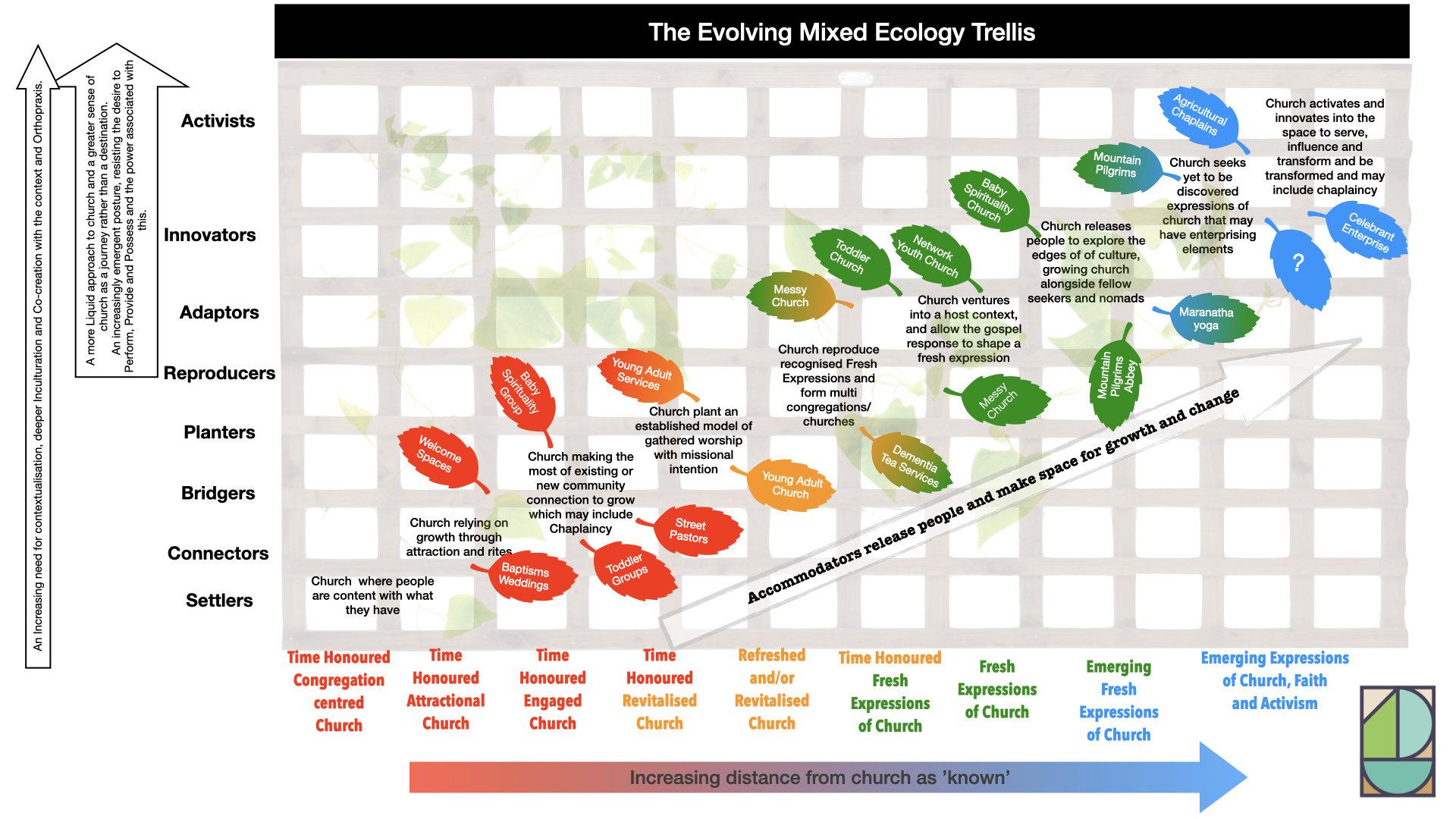
2.Mixed Ecology Trellis – lots of dioceses have found the Trellis helpful to describe and value the whole Mixed Ecology of church, but don’t realise that it can be operationalised as a diagnostic tool both for leadership development and to Scale Out at local and regional levels.

3 Theory of change development – if you aim at nothing you hit it. Recent sessions helping people explore the why behind what they do have been helpful in designing better processes. This not only ensures that what they value is front and centre but that these values inform and drive real change. Too often organisations talk about being values driven without a real understanding or process to ensure they translate in action and lasting change.

In the end, perhaps the greatest gift we can offer is to hold space and to trust that in the compost something beautiful and unexpected can take root.

“We are all in the system. The truth is at hand and it’s held with an open palm… the kin-dom is so much more than we can imagine.”

For a conversation on what I can offer your organisation or diocese please GET IN TOUCH


Hopeium, the church, and change

In church systems and institutions, it’s not uncommon to encounter a phenomenon of “hopeium.” It’s that heady mixture of optimism, faith, and a dash of magical thinking that makes us believe everything will be okay—if we just believe hard enough. On one hand, this hope can be a balm. After all, hope is foundational to the Christian story: the hope of resurrection, of renewal, of God’s kingdom breaking through. But what happens when hope becomes detached from action, critical reflection, or adaptive change? That’s when hopeium can turn toxic.

Toxic hopeium often shows up in church systems grappling with deep-seated challenges: declining influence, outdated structures, or a widening gap between institutional priorities and the needs of the world. Instead of grappling with the hard realities, institutional leaders might cling to vague promises of revival, grand but unfocused visions, or the comforting refrain of “God will provide.” While it’s true that faith can move mountains, it’s also true that someone has to pick up a shovel. When hope is used to paper over systemic issues or avoid making tough decisions, it can lead to stagnation, disillusionment, and a cycle of institutional inertia.

Consider the denomination that launches a major strategic initiative every few years, each time heralded as the solution to declining membership or cultural irrelevance. Resources are poured into programs and campaigns, but the underlying issues remain unaddressed: the inability to engage with a rapidly changing society, resistance to adaptive change, or a leadership culture that prioritizes preservation over mission. Hope, untethered from thoughtful strategy and missional humility, becomes a narcotic. It numbs us to reality instead of equipping us to transform it.

And yet, hope is also a gift. It’s what inspires institutions to dream of a renewed role in society and take risks for the sake of the gospel. The challenge, then, is to ground institutional hope in adaptive change strategies that acknowledge reality while pointing us toward renewal.

So, how can church systems navigate this tension? The first step is honesty. Institutional leaders need to adopt a posture of missional humility, recognizing that no single program or vision will fix systemic issues overnight. Missional humility invites us to listen—to God, to our communities, and to one another—and to admit where we’ve fallen short. This isn’t about doom and gloom; it’s about clarity. Only when we understand the landscape can we discern the path forward.

Next, we need to pair hope with action rooted in adaptive change. This means moving beyond technical fixes to addressing the deeper cultural and systemic shifts required for renewal. It might mean dismantling hierarchies that stifle creativity, investing in grassroots initiatives, or fostering a culture of experimentation and learning. Adaptive change requires courage—and a willingness to fail—as we navigate uncharted territory.

Finally, we must cultivate a theology of hope that’s robust enough to withstand setbacks. Christian hope isn’t about quick fixes; it’s about the long game. It’s about trusting that God is at work, even when we can’t see the fruit of our labors.

Hopeium, in its toxic form, can trap church systems in a cycle of false expectations and inertia. But hope, when rooted in truth, humility, and adaptive action, can be a powerful force for institutional renewal. The difference lies in whether we use hope to escape reality or to transform it. As I prepare for my next stage with Alchemy At The Edge I want to harness the transformative power of hope.

The Mixed Ecology Trellis – a watershed moment?

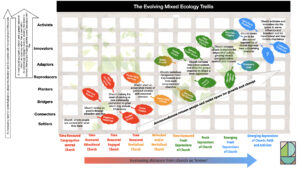
Over the past few months I have been using an innovation technique of Pitch and Exhibit to further my thinking on Pioneering and Church. What has become clear over the past week or so is that what has been emerging as fresh expressions, and pioneering expressions of church has matured and is now firmly part of the landscape of the church in the UK and consequently we need a better way to describe the mixed ecology of church that is now present in so many communities and spaces. We have long said that Time Honoured church and Fresh Expressions have distinct needs, but we also know that they need each other. If pioneers have the gift of not fitting in, when we also see them as being a gift to the church, conversations and practice take a creative turn. We have experienced this in Cumbria and in my previous post I failed to adequately recognise just how far we have come. It is clear through church history that both modal and sodal expressions of church are required to help everyone flourish but more than that, when there are good relationships between the two, significant cultural systemic change could be achieved.  I think we are very close to a watershed moment where we can observe the church Cumbria and in places beyond and really begin to shed light on what a mixed ecology of church might look like and how it interconnects and relates to one another. The image below is an attempt to capture this. You can find a larger image as a jpeg HERE or  in a PDF here

A few things to say about the Trellis:

  • We have been reaching for a more organic image than the spectrum and I hope this captures more the ecological element and interconnectedness of the Mixed Ecology. You can’t see it amazingly well as I need to fade it but there is a vine that weaves and interconnects across the different elements, traditions and approaches. This is to try and help people see this in a more patterned and less linear way.
  • We have deliberately moved away from and taken out the specific pioneer words, recognising that we are in a new space. We all have parts to play and we are one Church in many expressions with different gifts and need one another. This is not to say pioneer language is redundant indeed it remains critical in creating the space and continued imagination we need in the institution to reach the breadth and diversity of the communities serve.
  • We have removed the sense of Venn circles for a more fluid and interconnected approach.
  • The left hand arrow is deliberately split into two to capture the learning from the original pioneer spectrum that at some point(s) we need a distinct and deliberate shift in posture if we are to reach deeper into our cultural context. This is particularly the case as you move towards Innovation and Activism.
  • Accommodators has been one of the words we have wrestled with. It is meant as generous space makers, leaders who see that Time honoured and Fresh Expressions need each other. Accommodators are leaders who are secure enough to let others flourish and generous enough to let people go to new places they may never travel, but nourish and support them. Accommodators are not those begrudgingly making room for new things, but those who set people free to build the kingdom in the now and not yet.

I have said “we” in the wording above as the pitch and exhibit approach I have used means this has been developed collaboratively and I am grateful to all who have contributed over the past months and weeks. There is a lot to be said about the relationship between the spaces and particularly about the relationship between the centre and edge. Indeed I would even say the language of centre and edge is now problematic as  in a mixed ecology centres and edges are hard to find but that’s for another blogpost.


Connecting the pioneer spectrum to the mixed ecology

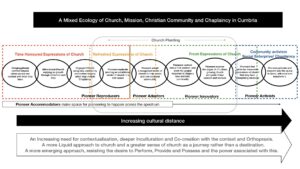
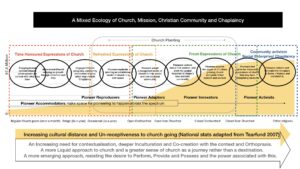
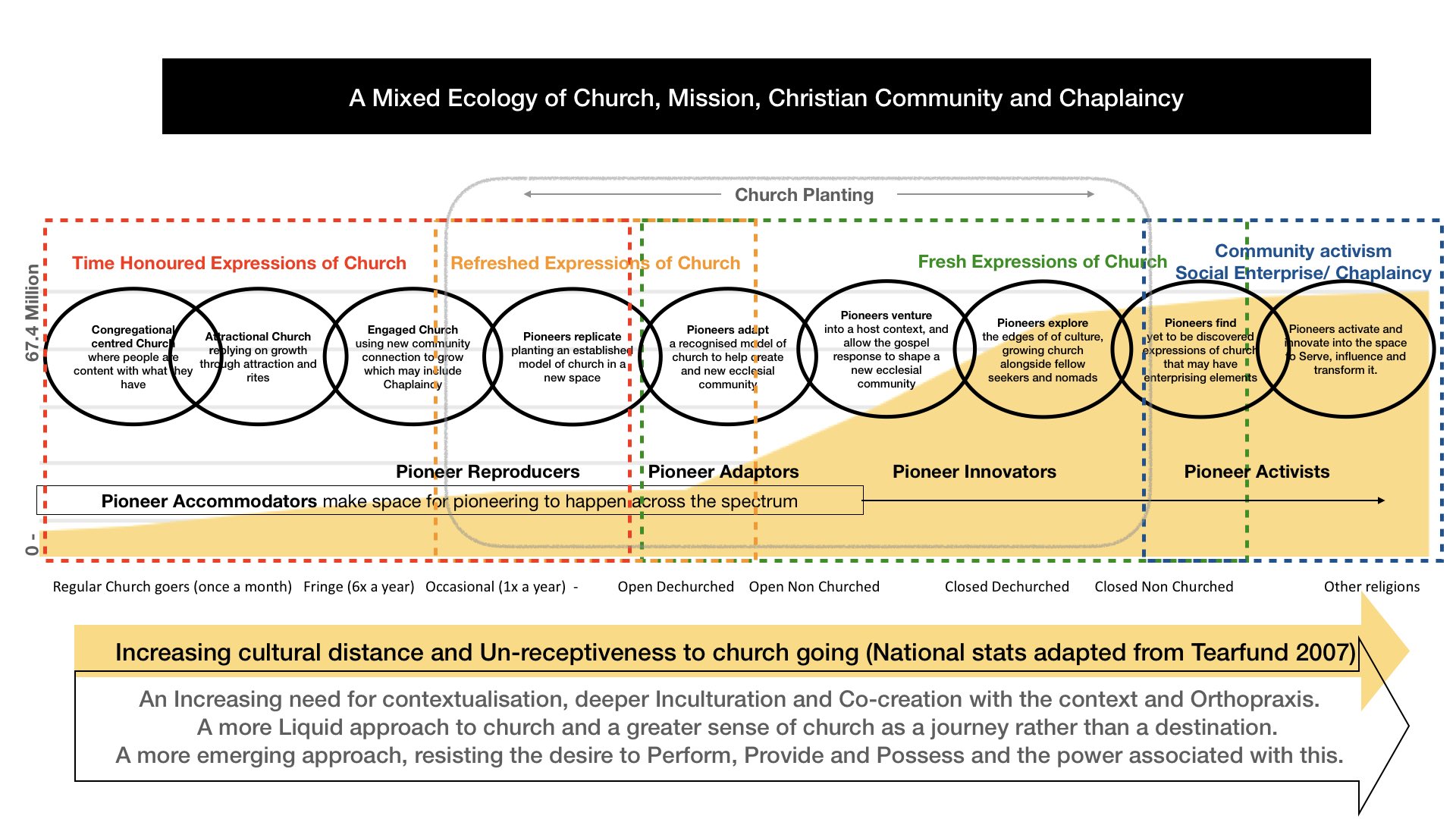
With some other pioneers in Cumbria I’ve been thinking out loud about how we embed pioneering more into the systems. This meant having to do some thinking about what a #mixedecology of church might look like, how it fits together, and how this connects with some of the other research out there on things like how receptive people are to church etc. it’s still a work in progress and all models are wrong but some are helpful. I’m really grateful to Paul and Tina for their work on the pioneer spectrum that in some ways built on a few ideas about a typology of church I developed here.  This attempt draws on some of that typology and takes the spectrum idea but expands it for the mixed ecology. I’m still not sure where hermits and other things fit but here’s my starter. The first image was where we started here in Cumbria. You

This second image is an attempt to capture some of the wider research on peoples views of church and potential reach, building on some of our research as part of our Reaching Deeper project. You can see a larger version here 

The valley in the hand.

If I have any known knowns it is the reality of Jesus, who walks before, beside and behind me, who encompasses me and who is good news to the depths of my soul. It is a soul knowledge where definition of who, and how, of why and what fade into insignificance. It is soul experience of love and care, of positive regard and compassion beyond feelings or formulas. It is a soul space where deep meets deep with an acceptance that is unconditional and independent of schemas and systems and a call that is too easily reduced to a method and corrupted into a mechanism. Yet we in our human frailty rely on these methods, definitions, systems and schemas to try to communicate something of that reality that we experience.

We hold stardust in our souls but our words are grains of sand slipping through our fingers. We feel such welcome in our being but offer a coir mat stamped with a word that cannot possibly convey the depth of acceptance we know. Our minds are expanded and neurons fizz with an energy that is beyond logic but we offer a recipe that can only be a bland version of the delights we know.

So how do we share this good news, how might we convey that deeply held known? What can do justice to the story that jumped off the page, out of pulpit, beyond the building and calls all walls to dust? Might we simply live and try to tell the tale more honestly, more openly bearing witness to the questions we still have and in doing so communicate the deeper truth beyond. Can we seek out the deep soul sparks in others to listen and learn. Might we let go of our formulas, systems, equations, to be still and still moving as we journey with others and the Other within the lifeline etched like a valley in the palm of Christs hand.

Building velocity

From SpaceX via Unsplash

Today I spotted Apprentice to Jesus, which was initiated by the wonderful Cannon Chris Neal. Chris was an amazing human, who had a huge impact on my thinking and ministry, not least because he coined the phrase “gravitational pull” in relation to pioneering in the institution. He would talk about the gravitational pull of inherited church as a double wrapped paradigm. There’s the culture/tradition that has been placed around the original (dissenting)idea as one layer ie the way we do things around here. Then the second structural layer of leadership hierarchy etc. Chris used to say pioneer projects need enough velocity to break that gravitational pull. Like a rocket needs the boost to break gravity and head towards the moon until the moon starts to pull it forward. I hope I will always have the courage to ride with the Holy Spirit or hang on to her coattails towards the new. However I wanted to reflect on the years since Chris’ passing some of the lessons that I have learnt that may help us reach the velocity needed.

Theres five ways I have identified so far to help create the velocity needed to break the gravitational pull. The first is the heretical imperative (and I’ve played with idea countless times across this blog) but today’s orthodoxy is yesterday’s heresy and a way into this is to embrace the pioneers on the edge and those pioneering beyond the boundaries. In Cumbria we have been gifted with some amazing pioneers on the margins following the Holy Spirit into new places as they reach new people and discovering new ways of thinking and theological insight as they go. This is the gift of the 3rd space fXs.
The second is the need for Authority dissenters (those in power in the system) to work with and release the Pathfinding Dissenters. Like the rocket needs the tower at the point of lift off and the people back at base (think Apollo 13 With images of the people behind the screens) helping the rocket break out we need the space and and support to get going, keep going and break out. It’s even better if you can launch several rockets from different spaces at the same time or spot those that may have already launched.

So the third is to network pioneers who are following the spirit into new things as the old system is dying. This network is vital in building the resilience needed, as things get tougher and the pioneers travel further out. But we need to watch this (see previous post). However through the network and community created pioneers can build the resilience needed to get through the ceiling whilst the old is dying and dream together of new ways. Connected to this is my fourth area which I think is something about scale and momentum, telling the stories of these pioneers and realising this isn’t some random one off but taps into the tradition of new life, of seeds dying, new wine skins that is happening all around us if we only have the eyes to see.

Lastly we need to recover our dissenting traditions, recover that history, and find stories from the tradition that fuels and connect the current pathfinders with the pathfinders of old. And here I don’t just mean those early saints or desert fathers and mothers, but more recent pathfinders in the tradition, and every tradition has them, for some it’s those dissenters that were part founding story like Wesley in Methodist, for others it’s pioneers who were misunderstood at the time, like Dorothy Day, Guteriezz, Punton or Rawnsley. Knowing our founding stories and finding those who have pioneered locally in the past is rocket fuel.

And as helpful (or not) as these reflections maybe as Chris would always remind us it does come back to being an apprentice of the master Jesus the pathfinder and perfector of our faith.

Lets dare to be the Mixed Ecology of church

As I wrestled with the non-dualist ways of being missional church I was seeing in and through my practices with young people back in the late 1990s and 2000s, I became a big fan of Walter Brugemann’s work and particularly his work on orientation, disorientation and reorientation in the Psalms. This alongside Hegel’s thesis, anti-thesis and synthesis, and Paul Ricour’s work on naïveté, complexity and recalibration, this flow and process started to give me a language and frame of reference for the less dualist way of being that I was sensing and observing in the emerging church. Then through my post-grad I stumbled onto the idea of an emerging Habitus that Bourdieu identifies as something that emerges as an interplay between free will and structures and is developed over time. Habitus is shaped by both past events, present practices and our ideas (perceptions) of these events and practices. ie coherence (reorientation, synthesis, recalibration) emerges through the process. In this sense habitus is created and reproduced unconsciously ‘without any deliberate pursuit of coherence… without any conscious concentration’ see here for more info.

Both the national church of england (here) and in our county we are looking to become a deeper mixed ecology of church. I have two thoughts on this. Firstly it seems entirely natural and in line with the flow and process I first saw in Brugemann and more recently in Richard Rohrs work on Order, Disorder and Reorder – Institutional church, Emerging church to Mixed Ecology. It’s pattern we see through church history and before throughout the scriptures, all of which is very positive. However, my second observation is how much we lose when we try to organise, and how an emerging habitus comes without conscious concentration. So I find myself caught between a place of concern and hope. A concern that the mixed ecology become a bit like Bonhoeffer’s saying “The person who loves their dream of community will destroy community, but the person who loves those around them will create community.” A hope that the hard work of the emerging habitus of mixed ecology is sufficiently embedded and that we are in this new place of metaphor and symbol, of connectivity, of Time honoured and Fresh Expressions of church, and not seek to return to a modernist approach that categorises what is happening as the mixed ecology. But live in the spirit with her daring mixed ecological metaphors of wind and water that resist categorisation, control and keep us humble and always emerging.