
Reframing Discipleship

I’ve recently been asked to speak at a conference on discipleship and the way my brain works means when I’m into a subject I start seeing connections every where. So Im finding myself following two conversations happening in British Christianity right now that belong together but rarely meet.

The first is about how the church speaks into public life,how Christians engage politics, culture, and the fractured common good without either retreating into irrelevance or baptising the spirit of the age. Mark Clavier has written compellingly about this recently, arguing that what the church needs is not better arguments but a more credible common life: communities so genuinely shaped by the gospel that their public witness carries weight because of what they are, not merely what they say.

The second conversation has been quietly unravelling across the edges of the church for thirty years. It began in the alt.worship and Emerging Church movements, continued through Fresh Expressions and pioneer ministry, and asks a harder question: not just how the church speaks to the world, but how the church engages and forms people at all.

My contention is that these conversations have the same root, and until we learn to hold them together in dialogue we will make little real progress.

The Half-Finished Reformation

The Emerging Church movement did something genuinely important. It took culture seriously,not as a threat to be managed, but as the medium through which people actually live, encounter God, and become themselves. It recovered missio dei thinking: the idea that God is already present and active in the world before the church arrives, and that faithful mission begins not with proclamation but with attention. It rediscovered liturgical experimentation, contemplative practice, radical hospitality, and the prophetic edge of the tradition.

But there was a fault line running through it that we have not yet fully named.

In too many cases, culture was taken seriously as a technology for mission,as the means by which the church could become relevant enough to be heard,while the inherited content of discipleship remained largely untouched. The worship changed. The coffee improved. The lighting got darker and the music more atmospheric. But the underlying assumption,that the church holds the truth which it then pours into people,quietly persisted. Missional humility shaped the front door, but not the whole house.

The missio dei was applied to evangelism. It was not, for the most part, applied to formation.

And this matters, because what the missio dei requires is not just that we listen before we speak in the evangelistic encounter. It requires that we be genuinely changed by what we hear,that our theology, our practice, our understanding of God is reformed by what the Spirit is already doing in the lives of those who are not yet, or not yet fully, inside the tradition. The listening is not a tactic. It is an epistemological commitment. It is the belief that truth is not simply possessed by the church and dispensed to others, but that it emerges,partially, provisionally, always requiring further reformation,in the encounter between the tradition and the world.

This is not theological relativism. It is the recovery of a genuinely reforming gospel: semper reformanda, always being reformed.

The Inherited Church’s Own Wound

But this critique is not only for the emerging and fresh expressions stream. The inherited church has its own version of the same problem, and Clavier’s essay names it precisely, even if he stops short of tracing it to this particular root.

He writes that what is needed is not better techniques of political communication but the recovery of the church’s “common life”,its integrity, its distinctiveness, its capacity to form communities that embody something recognisably different from the surrounding culture. He is absolutely right. But the question he invites, and which presses further, is this: what kind of formation produces that kind of community?

If the answer is the existing curriculum,the same confirmation classes, the same Alpha courses, the same preaching-centred model of instruction,then we are asking formation to produce transformation it is structurally incapable of delivering. We are hoping the old pedagogy will produce the new community. It won’t.

Clavier observes that in the assisted dying debate, the bishops who spoke most compellingly did so because of their “long pastoral familiarity with death and dying,their proximity to suffering.” What formed them was not primarily the lecture theatre but the encounter. The living and dying of real people in their pastoral care reformed their theology, their instincts, their way of speaking. That is exactly the point. Presence and attentiveness shaped them.

But our discipleship systems rarely model this. They model transmission: the expert to the novice, the formed to the unformed, the front to the rest. Formation happens at people rather than withthem and from the edges of their experience.

What Luke 5 Teaches Us About Formation

The image I keep returning to is Luke 5. Jesus borrows Simon’s boat. The Son of God, at the beginning of his ministry, is dependent. He does not arrive with a programme. He improvises with what is to hand. When he sends Simon out into the deep, he does not override Simon’s resistance,he holds the tension, and waits for Simon to risk something from his own fragile agency.

The discipleship does not come from the assertion of authority. It comes from the creation of a space in which the other person takes the risk.

And it is worth remembering what immediately precedes this scene: Jesus has already been to his hometown synagogue, announced his manifesto from Isaiah, and nearly been thrown off a cliff for it. Solo expertise, the confident assertion of authorised knowledge, nearly got him killed. What we see at the lakeside is a pivot: slower, collaborative, beginning not with proclamation but with borrowing. The missional posture and the formational posture are, in the end, the same posture.

This is the posture our discipleship has largely lost. We have confused teaching with discipleship. We have mistaken the transmission of content for the formation of persons.

The 2.5 Problem

Here is a number that should trouble us more than it does.

Fresh Expressions research consistently shows that for every person from a church background in a fresh expression of church, approximately 2.5 come from outside the tradition,from the de-churched or the never-churched. These are people who are being formed in faith in communities where the majority of voices are not carrying inherited Christian frameworks. They are, in the fullest sense, disciples-in-formation who are bringing their own encounter with God into the community,an encounter that precedes and often exceeds what we might have expected.

If we take seriously that the Spirit is at work in those people before they arrive,and we must take this seriously if we believe anything about missio dei,then those 2.5 people are not raw material to be formed. They are teachers as well as learners. They carry knowledge about God that the person who has read the Bible a hundred times may not have. The question “what are you noticing?” turns out to be a more theologically charged question than any catechism.

Our discipleship structures are not designed to receive this. They are designed to transmit, not to be reformed by what arrives at the edge.

Orthodoxy as Journey, Not Fortress

This brings us to perhaps the most uncomfortable claim: that a genuinely reforming approach to discipleship means allowing our orthodoxy itself to be reformed,not abandoned, but continually unfolded,through the encounter with those who come from outside.

The Reformation instinct was never simply back to the sources as a conservative retrieval. It was ever being reformed as a permanent posture of the church before the living Word. The tragedy is that most of what passes for formation in inherited church, and much of what was practiced in the emerging church too, treats orthodoxy as a deposit to be transmitted rather than a living tradition to be inhabited and extended.

When orthodoxy becomes a fortress to be defended rather than a journey to be shared, it produces disciples who are anxious rather than rooted, brittle rather than resilient. They can articulate the propositions but they cannot bear the weight of genuine encounter with difference, with doubt, with the person who says I’m not sure I believe, but something is happening in me.

What if that person is not a problem to be solved but a gift to be received?

What if the person whose spirituality has been shaped entirely outside our tradition,who has practised the silence, the justice, the solidarity of Jesus before they could name it,is actually offering us a fuller picture of God than we currently hold?

This is not a call to theological vagueness. It is a call to theological confidence of a different kind: the kind that does not need to control the encounter because it trusts that God is present in it.

The Double Dividend

If this account is right, then the recovery of a genuinely missional, listening-first approach to discipleship does not just address the Fresh Expressions challenge of evangelism and belonging. It addresses exactly the challenge Clavier identifies for the church’s credibility in public life.

The communities Clavier hopes for,communities of genuine trust, mutual obligation, and practiced virtue; communities that embody something recognisably different from the hyper-individualism of consumer culture,are not produced by better theological education alone. They are produced by communities that have learned to be genuinely changed by one another. That have learned to receive the knowledge and experience of the newest, least-formed member as a gift. That practice the epistemological humility which is finally just another name for love.

A church that has learned to listen first in its formation will also listen first in its engagement with the world. The humility is not a tactic. It is a character. And character is formed, or it is not formed at all.

The church’s crisis of public credibility and the church’s crisis of formational imagination are the same crisis. We have protected our position,in culture, in doctrine, in the pedagogical arrangement of the room,rather than trusting the reforming power of the gospel to do its work through genuine encounter.

What Would This Look Like?

A few possibilities, across both streams.

But first, a prior commitment that shapes all of them. The Emerging Church was right to take culture seriously. Its error was treating culture primarily as a technology,a delivery mechanism for mission, a way of lowering the threshold so that the real content could get through. What it did not fully follow through was the more radical claim: that culture is sacred. Not because everything in it is good, but because it is the medium in which image-bearers of God are already living, already seeking, already partially receiving what God is giving. Every person who comes into a process of discipleship arrives bearing the imago dei,already marked by God, already in some way responsive to the divine, already shaped by the Spirit’s work in the life, relationships, and culture that formed them long before the church arrived. If we believe this, then culture is not the obstacle to be overcome before formation can begin. It is the place where formation has already begun. Our task is not to replace it but to receive it,to ask what God has already been doing in this person, in this community, in this cultural moment,and to let that question reform us as much as it opens them.

With that commitment in place, some practical directions:

In inherited church: preaching and teaching that genuinely positions itself as invitation rather than instruction,that makes space for congregational encounter with the text, that asks “what are you noticing?” rather than “here is what this means.” This isn’t a lowering of theological ambition; it is the recognition that the imago dei in the person in the pew means they are already a bearer of insight, not merely a recipient of it. Not the abandonment of theological depth, but its recovery in relational and participatory form.

In fresh expressions and pioneer communities: an explicit commitment that the people who arrive from outside the tradition are not just the object of mission but agents of ongoing revelation. Their culture,however unfamiliar to us,carries the sacred weight of lives in which God has been present. Formation structures that are built to receive and be reformed by their insight do not simply make the newcomer feel welcome; they honour the imago dei they carry and take seriously the Spirit who got there before us. The 50-year fresh expressions that have lasted have done so precisely because they kept learning from those at the edge.

In theological education and ordination training: a pedagogy that models what it teaches. If we want leaders who can hold genuine encounter with the other, we need formation processes that do not merely transmit the tradition but demonstrate what it looks like to be changed by it. This means training that takes cultural context not as background noise but as theological data,that asks what God is already doing in the culture of those being served, and expects that question to shape the minister, not just the ministry.

In public engagement: a recognition that the church’s witness in the political sphere will only be as credible as the quality of formation that produces it. The bishops who speak with authority are those who have been formed by pastoral presence and genuine encounter,with suffering, with difference, with the sacred weight of other people’s lives in cultures not their own. That formation cannot be manufactured after the fact. It has to be built into the ordinary life of the community, from the beginning, by communities that have learned to see the imago dei in those they are most tempted to speak past.

Conclusion: The Empty Hand

Jesus in the wilderness refuses three shortcuts: to provide, to perform, to possess. He chooses the empty hand.

The church’s temptation,in its public witness, in its engagement with culture, in its approach to formation,is the same three shortcuts. To have all the answers. To perform expertise. To possess the truth.

The recovery we need is not a new programme. It is a posture. The posture of the one who borrows a boat before they preach. Who waits for the other to risk something. Who is genuinely surprised by what emerges from the deep.

The newest, most uncertain voice in the room might be the one who knows which way the Spirit is moving.

We have built our discipleship to transmit what we know. We need to rebuild it to receive what we do not yet know,confident, finally, that the God who is already in the world ahead of us is more than capable of meeting us there.

Semper reformanda. Always being reformed.

That is not a concession to the spirit of the age. It is the oldest claim of the gospel.

Comments and responses welcome. This piece draws on conversations in the Fresh Expressions and Emerging Church traditions, and engages with recent writing by Mark Clavier (Well-Tempered) HERE and Andrew Jones (Tall Skinny Kiwi). HERE

Truth that Moves: A Christocentric Synthesis (3 of 3)

In the last two posts I have traced the solid foundations of the cathedral and wandered through the experimental “Third Spaces” of the pioneers. We have seen the 1960s struggle between the rigid and the radical and explored the pioneer charism of 1990 as an inroad to the tension. Now, we must ask: Where does this leave us?

The deadlock between “Absolute” and “Relative” Truth often feels like a choice between a statue and a cloud. A statue is reliable but dead; a cloud is atmospheric but offers no shelter. As Christians, however, we are called to follow a Person.

For me, the synthesis of these ideas didn’t happen in a library, but through a slow immersion in the culture and finding a way of being christian in a context different to my upbringing.  It was a combination of prayer, spiritual disciplines, engagement with the missio-dei I was discovering on tough places, courage to go to a new place, the insightful guidance of my spiritual director, and the literary explorations of Susan Howatch. Whilst it was practice that had the biggest impact I’m going to draw on Howatch to try and give to words to what I mean.

Howatch’s great achievement was showing that “orthodoxy” isn’t a set of dry rules, but a dynamic. In her novels, the characters who thrive are those who realise that the Logos (the Absolute Word) has become Flesh (the Relative Human). Truth, therefore, is an Event. It is the “Truth that moves.”

I once thought that “knowing the Truth” meant I no longer needed a guide. I was wrong. The more I understood the “mystical” dimensions of faith, the “glimpses” of Reality that Howatch describes and I experienced in mu missional journey, the more I realised I needed a spiritual director to help me anchor those experiences in the “practical” reality of the Church.

A spiritual director acts as a “theological pioneer” alongside you. They help you see that the Spirit isn’t leading us into a new Truth that contradicts the old, but into a deeper Truth that reflects the living, breathing, acting God. This is the heart of Christocentric theology: Truth is not a static object we study, but a relationship we inhabit.

In the Starbridge series, the resolution of conflict often comes when a character stops trying to “control” the Truth and starts to “live” it. This is the synthesis of the Practical and the Mystical, the practice and the theory, the action and reflection. The Practical (The Aysgarth impulse): Reminds us that Truth must be lived out in our ethics, our politics, and our mundane responsibilities. The Mystical (The Darrow impulse): Reminds us that the Truth is always larger than our understanding. It keeps us humble.

For a contemporary faith community, this means that “Truth” is found in the practice of discipleship. We do not learn the Truth so that we can act; we act (follow Christ) so that we may know the Truth. The novels helped me see that faith was about a willingness to sit with the “unsolved” nature of God until the Truth reveals Himself in action. But too many of us stopped here, we failed to apply the same missio dei impulse, the same humility to learn from other into our discipleship programmes and approach. We let the genie out of bottle in mission but placed the top back as people came to faith, so failed to keep walking towards the new places that were opening up.

As we look at the fractures in our “Post-Truth” world, the Church has a unique gift to offer. Not the gift of an “Absolute” used as a weapon, nor a “Relative” that leaves people drifting. We offer the gift of a Relationship. To say “Jesus is the Truth” is to make a claim that invites a lifetime of exploration. Like Nicholas Darrow at the end of Mystical Paths, I have found that the “Truth” is far more complex, dangerous, and beautiful than I ever imagined. It required me to step out of my self-sufficiency, seek the wisdom beyond and embrace the beautiful, messy tensions of the Christ of the gospels and we are called to today. So perhaps the question is not “Can we define the Truth?” but rather: “Are we willing to be redefined by the truth that lives and moves and has its being in Christ and is revealed as we journey with others?”

Beyond the “Cool” Church: Pioneering as Theological Reflection (2 of 3)

In the 1990s, the UK church scene felt like it was holding its breath. The old structures were fraying, and a new movement began to stir. “Alternative Worship” and the “Emerging Church.” To the outsider, it looked like a desperate attempt to be relevant: DJs in the sanctuary and beanbags in the aisles.

But for those of us involved, it felt like a pioneering mission into a new epistemological frontier. We weren’t just changing the music; we were trying to figure out how to be “truth-tellers” in a postmodern culture that had given up on the very idea of Truth.

In the Church of England, speaks of pioneers, as people who “connect with those outside the Church, working alongside them to create fresh expressions of Church in those places. Pioneers are also leaders of innovation, with a gift for seeing what God is doing and responding creatively to it”. I dont think adequacy reflects the Pioneer Charism as it is to focused on practice. For me the contained within the Pioneer Charism is something about not just pushing into new areas of practice but also new ways of thinking and being christian. My own journey into this space was fraught with the same “evangelical-liberal” tension Howatch describes so vividly. I wanted to be faithful to the Gospel (the evangelical impulse) but I couldn’t ignore the complexity of the modern world (the liberal impulse). It wasn’t until I embraced the wider nature of the pioneer charism that I could start to integrate the two and truly start to livie in the fullness of who I was created to be.

It was during this season of “deconstruction” that the need for a spiritual director became undeniable. In Howatch’s Mystical Paths, Nicholas Darrow is a brilliant, charismatic young man who thinks he can handle the spiritual “edges” on his own. He nearly destroys himself in the process. It is only through the guidance of older, wiser “Abbot” figures that he learns to discern the difference between his own ego and the movement of the Spirit.

This mirrored my own experience. To be a “pioneer” is to walk into the fog. Without a director, someone to hold the tension of balance for me, I would have likely drifted into a shallow relativism or retreated into a defensive fundamentalism.

The Emerging Church was an attempt to move from Truth as a proposition to Truth as a language. Drawing on the “cultural-linguistic” model of theology, we began to see that “knowing” the Truth was less like passing a math test and more like learning to speak a mother tongue.

Howatch’s novels capture this perfectly. Her characters don’t find “Truth” by reading a manual; they find it by stumbling through the messy, “Anglican way of being”—participating in the sacraments, engaging in honest (and often painful) confession, and slowly learning the “grammar” of God’s grace.

The overly simplistic critique of the 90s movement was that it became “post-theological”, all style and no substance. This is the danger when pioneering isn’t rooted in theological reflection and connected to the wider charism. However for those of involved it was and still is deeply theological.

If we only innovate in practice (lighting, music, seating) without innovating in our understanding of Truth, we are merely rearranging the deck chairs. The true task of the pioneer and the task of the spiritual director is to look at the specific context (a housing estate, a digital community, a modern office) and ask: “What does the Truth of Christ look like here?”

What the 90s and 00s taught me is that Truth is often more visible from the margins. When you are at the centre of an institution, “Truth” feels like maintenance. But on the edge, you realise that Truth is not something you possess, but something that possesses you.

This brings us back to the Darrow family in Howatch’s saga. They are constantly drawn to the “edges” of psychic experience and social norms. They show us that the way isn’t about having all the answers; it’s about having a structure, (in Anglican terms a liturgy, a director, a community) that allows you to ask the hardest questions, go to new places, the edges of the map without falling off.

In our final post, I will try to synthesize these threads and propose that the resolution to the absolute-relative divide is found not in a “what,” but in a “Who”, the Person of Christ, who is the Truth that moves.

The nature of truth (1 of 3)

Following on from the last post a letter to the dust 19/4/26 I have been rereading the Howatch novels and which has prompted these three posts.

The air in a cathedral  is never quite still. It carries the scent of damp stone, ancient dust, and the faint, lingering ghost of incense or candle. To stand in the nave of a great cathedral for me can help me feel anchored to something immutable a “Truth” carved in granite. Yet, as the sun shifts through the windows, the light always transforms the space. What was solid becomes ethereal; what was in shadow becomes gold.

For years, I stood in such spaces feeling a profound disconnect. I came to faith late in lay teens and attended an evangelical church rooted  on the “stone” of the absolute, propositional truths of the faith, but I lived in the “light”, a world where everything felt relative, shifting, and subjective. It wasn’t until I stumbled upon the Starbridge novels of Susan Howatch that I began to understand this wasn’t just my private struggle, but possibly something very Anglican.

Historically, Christian theology treated Truth as a static monument. It was Adaequatio rei et intellectus, ie Truth is basically the “perfect match” between the thoughts in your head and the reality of the world around you and could be distilled to an objective reality. In this framework, Truth was a deposit to be defended. It stands outside of time, solid, absolute and unchangeable.

Its where Thomas Aquinas meets Plato, Aristotle, and Socrates,  the world of the Sentences of Peter Lombard and the Summa of Aquinas. But for me, reading Howatch’s portrayal of the mid-20th-century Church of England, I realised that this “absolute” truth often manifested as a rigid moralism. In the character of Neville Aysgarth, we see a man who mastered the “Practical” side of the Church, the administration, the legalism, the outward appearance of Truth, while his inner life remained a fractured landscape. He reflected the “Practical” faith of the establishment: structured, but often calcified.

The Enlightenment moved the seat of Truth from the objective to the subjective. Suddenly, the light was no longer just on the stone; the stone was defined by how the eye saw the light.

As I navigated these waters, Howatch’s novels served as a map for something wider. Faith at its best, refuses to choose between the cold stone of fundamentalism and the vaporous mist of pure subjectivism. It seeks a via media the middle way. However, this middle way is often a place of intense tension and as previously blogged about can be to easily confused or corrupted by power. .

By the 1960s, this reached a breaking point. When John Robinson published Honest to God in 1963, he argued that the “God out there”, the absolute, objective monarch, was no longer a viable category. For many, this was a betrayal. But for me, reading Robinson alongside Howatch’s Mystical Paths, it felt like a permission slip. I realized that my struggle with “Absolute Truth” wasn’t a lack of faith, but a call to look deeper, to find the “Ground of Our Being” rather than a distant deity.

In Howatch’s world, the tension is personified by the “Practical” Aysgarths and the “Mystical” Darrows. The Practical side demands a Truth that is clear, legalistic, and useful for social order. The Mystical side, represented by the visionary Jon Darrow, seeks a Truth that is experiential, haunting, and often dangerous.

I found myself caught between them. I came to faith in the “stone” of the evangelical  tradition, but I craved the “light” of a mystical encounter. The novels helped me name this: I was looking for a faith that could hold the evangelical-liberal tension without snapping. It was through these stories that I first realized I couldn’t navigate this tension alone. I saw in the characters’ lives the desperate, recurring need for a “Father Abbot” figure, a realisation that eventually led me to seek my first spiritual director.

The historical tension leaves us with a challenge: if Absolute Truth feels like a tomb, and Relative Truth feels like a mist, where do we stand? The answer, is found in those moments where the transcendent breaks through the mundane.

In my next post, we will step out of the cathedral and into the “Third Spaces” of the 1990s Emerging Church, exploring how a new generation, and my own younger self, attempted to re-read the Truth in a postmodern world, guided by the wisdom of the “pioneer.” Where I first saw those glimpses of transcendence breaking out of mundane: the flower forcing itself through the pavement that I wrote about when living on an estate and seeking to be present and the words that Jonny Baker put into a song “I have seen the hills a thousand times before but it took someone to point them out to me”

Today’s heresy, Tomorrow’s orthodoxy letting the Holy Spirit is ruin our comms plan!

I’ve always been fascinated by the role language plays in meaning making and for several years my walk of faith has been helped by entering into dialogue with nature through of emerging church space Mountain Pilgrims. Thomas Berry suggests humanity has broken The Great Conversation, the deep, ongoing dialogue between humans, the more-than-human world, and the wider universe.  We talk a lot, but mostly to ourselves and church is no different to any other eco chamber. It has developed a sophisticated internal language but often struggles to hear, let alone respond to, the voices of culture, creation and those at the edges questioning what counts as “orthodox.”

Berry’s concern was not simply about ecology but about language. When only one way of speaking is recognised as valid, everything else gets pushed to the margins.  That resonates with our ecclesial habits. The church has learned to privilege certain kinds of words, authorised, platformed, “sound” and to distrust improvisation, lived experience, and wild metaphors that do not fit existing systems.  I know even writing this several people will comment on how I’ve lost the plot, gone mad and am talking to trees again. The result is a narrowing of conversation and, with it, a shrinking of imagination.

One thing thirty years of mission has taught me is that that like G-d, Language is not a museum piece; it is a living, mutating thing, constant in its movement even when the printed page pretends otherwise.  Berry’s work suggests that meaning arises in the between in relationships, exchanges, frictions rather than in frozen statements detached from place and encounter.  If that is true, then a church that tries to manage its language purely through control (doctrinal, institutional, reputational) ends up disconnecting its words from the world they were meant to serve.

A similar concern sits behind recent reflections on how church handles its public voice: the drift from conversation into messaging, from mutuality into management.  When our words exist mainly as outputs, strategies, statements, carefully curated content, we are no longer participating in language as a shared, risky, evolving practice. We have moved from speaking with to speaking at.

The irony is that the Christian tradition, at its best, already knows that meaning is relational. The gospel of John points to Logos not as a static “word” dropped from the sky, but as a dynamic, relational presence through whom all things come into being.

Orthodoxy should be a faithful emerging conversation but too often it is treated as a fixed package, a set of statements that must remain untouched in order to be “true.”  But if God is encountered in history, in bodies, in place, then faithfulness cannot be about freezing language; it has to be about staying in truthful conversation as the world changes. This does not mean anything goes but it does mean that orthodoxy cannot be maintained by shutting down dialogue with those who unsettle us. The temptation is always to label the troubling voices as “unorthodox” so we don’t have to listen. But perhaps the deeper danger is a church that can repeat the right phrases while refusing the great conversation where the Spirit might be speaking in unfamiliar accents.

If orthodoxy is reframed as fidelity-in-movement, then the test of soundness shifts. The questions being asked are more about if this way of speaking or being deepens love of God, neighbour, and creation, or does it protect systems at their expense?  This is a very different conversation from a lot of what I hear and ff the church is to re-enter the great conversation, who or what are are the conversation partners we need need. None of these named below are new, but each reveals how thin our language becomes when separated from encounter.

1. With the more-than-human world

Creation is often reduced to backdrop or resource in church practice, something we “use” or “care for,” but rarely someone we listen to.  Emerging eco-liturgies, “wild church” practices and place-based spirituality are tentative attempts to let rivers, soil, seasons and species become conversation partners rather than illustrations.  What happens to orthodoxy when the groans of creation are treated not as background noise but as part of the community’s discernment?

2. With decolonising and marginal voices

Mission history has trained Western churches to imagine themselves as speakers and others as listeners.  Decolonising work insists that the roles must be reversed, or at least shared: theologies forged in colonised, racialised, and economically marginalised contexts need not only to be “included” but allowed to interrogate and reshape what the centre calls orthodox.

3. With shifting identities and bodies

Conversations around gender, sexuality, neurodiversity and family structures are often handled through statements rather than stories.  People are turned into “issues,” and language is deployed to control rather than to understand. Yet if the body of Christ is genuinely diverse, then these lives and experiences are not detachable from theology; they are part of the place where theology happens.  Staying in conversation here may mean discovering that some of our long-held assumptions were more cultural than Christlike.

4. With digital and symbolic worlds

Digital culture is not simply another channel for church messaging; it is a habitat where new forms of presence, authority and belonging are emerging.  Online communities, memes, gaming, AI, are all forming people’s imaginations long before they meet a sermon. A church that only uses these spaces to broadcast pre-formed content refuses the opportunity to learn a new dialect of human longing and connection.  Conversation here would mean showing up not as brand but as neighbour.

Berry writes of the need for a “new language” that can draw humans back into a mutually enhancing relationship with the rest of the community of life.  That newness is less about inventing clever phrases and more about recovering humility and recognising that our words must once again be accountable to the earth, to history, to those who suffer under our systems.

Perhaps this is where pioneers and locally rooted parishes have role: to keep pointing to the gaps between our official language and the real conversations happening at the edges.  To remind the church that the Spirit has always been ahead of us, out in the wild, teaching new words to those willing to listen.

Re-entering the great conversation will mean losing some of the safety that comes from tightly managed speech. It will also mean discovering that orthodoxy is not a fragile artefact to be defended, but a living stream kept fresh precisely because it flows through new landscapes, picks up new sediments, and keeps finding its way back to the sea and the source.

The changing face of trickster in systems change

Sunday Papers turned 21 last month and so I thought I would look back through some of the themes that have emerged over the years and the 950 or so blogposts. The figure of the trickster has been a restless but pretty constant companion, sometimes provocateur, sometimes guide, sometimes the shadow in the corner when certainty threatens to harden. Journeying back through the archive, I notice how my use of “trickster” has itself been tricky: adapting, morphing, much as the trickster does, to the movements and moods of the times and the evolving questions of church, systems, and cultural renewal. Gathering these together we can see her different guises and learn a few lessons along the way. 

Trickster as Disruption: Stirring the Comfortable

In the early days, trickster arrived in my writing as disturbance. Rooted in the stories of Hyde and the many mythic mischief makers, trickster embodied the kind of holy mischief needed to unsettle our ecclesial complacency. I wrote about the discomfort, border-walking, question-posing, edge-dwelling that trickster brings to stagnant communities. Trickster was the strange guest, misunderstood and sometimes unwelcome, who moved the conversation from comfort to confrontation (which probably also reflects my life stage at the time).

There is a necessary place for this sort of energy in organisations and systems facing calcification, when the status quo is defended with greater force than the call of the gospel or the pulse of life. In this stage, trickster is a mirror to stuckness and a living question mark for institutional “wisdom.” Trickster’s value here is not so much in having answers, but in disrupting, and simply tearing open space for something unexpected to begin.

Trickster as Emergence: The Playful Edge of Creativity

As time went on, my engagement with emergence deepened. Trickster moved from being merely an irritant to something generative, a figure not only to challenge boundaries, but to create new ones, or dissolve them long enough for new forms to emerge. The conversations about “emergent church” and “grace spaces” that led to Here Be Dragons revealed the need to dwell not just at the border, but also in the middle, where the boundaries blur and creation teems.

Here, trickster’s play becomes vital. The themes shifted: less about simply sabotaging structure, more about risking improvisation, learning from ambiguity, and allowing the uncomfortable laughter that comes when certainty recedes. Surprisingly, trickster’s lessons in play, parody, and improvisation offered a source of hope and resilience, essential for organisations learning to let go of the need for control and to make space for emergence.

Trickster as Companion: Deep Listening and Systemic Renewal

In more recent years, a subtler, deeper trickster has come to the fore. No longer relegated only to the borders or eruptions of crisis, this trickster appears as a companion in the slow, ongoing renewals of system and spirit. I found myself drawing on trickster stories not just for their disruptive potential, but as a wisdom tradition for co-creative leadership, deep listening, and navigating unpredictable terrain.

Now, trickster is invoked to remind leaders and communities that true transformation happens in liminal space, between the old and not-yet, in stories shared, questions asked, and boundaries re-imagined. The work is less about subversion for its own sake and more about fostering an adaptive, generative ecology where fresh forms of church and meaning can be discovered. Trickster joins the circle as both risk and companion: an invitation to stay open, responsive, and alive to the wild grace of emergence.

Using Trickster in Organisational Change: Practical Insights

Looking back, I see that the trickster’s role shifts with the system’s need:

• When a community is stuck or stagnant, trickster shakes the ground, challenging, exposing, disrupting.

• In seasons of uncertainty or growth, trickster invites play, risk, and improvisational imagination needed for the new to emerge.

• As change matures and practice deepens, trickster becomes a reminder to listen to what emerges with humility, to hold structures lightly, and to let stories and edges lead the way toward renewal.

In organisational and systemic change, then, trickster is not a one-off tool but a shape-shifter morphing between clown, sage, and the voice that asks the question no one else dares name. The journey through these stages is itself trickster-like a reminder that creative transformation is rarely linear, often surprising, and always a bit mischievous. So I think we let trickster take us further, rooting practice in tricksteresque space where the grace of emergence calls leaders and communities not just to survive disruption, but to welcome it as the soil in which new worlds may be planted. And in this, perhaps, the trickster makes our world anew, again and again.


As part of Alchemy At The Edge I’m thinking of developing three webinars based on these three trickster stages. If you are interested in this please leave me a comment or email me richard@alchemyedge.co.uk 

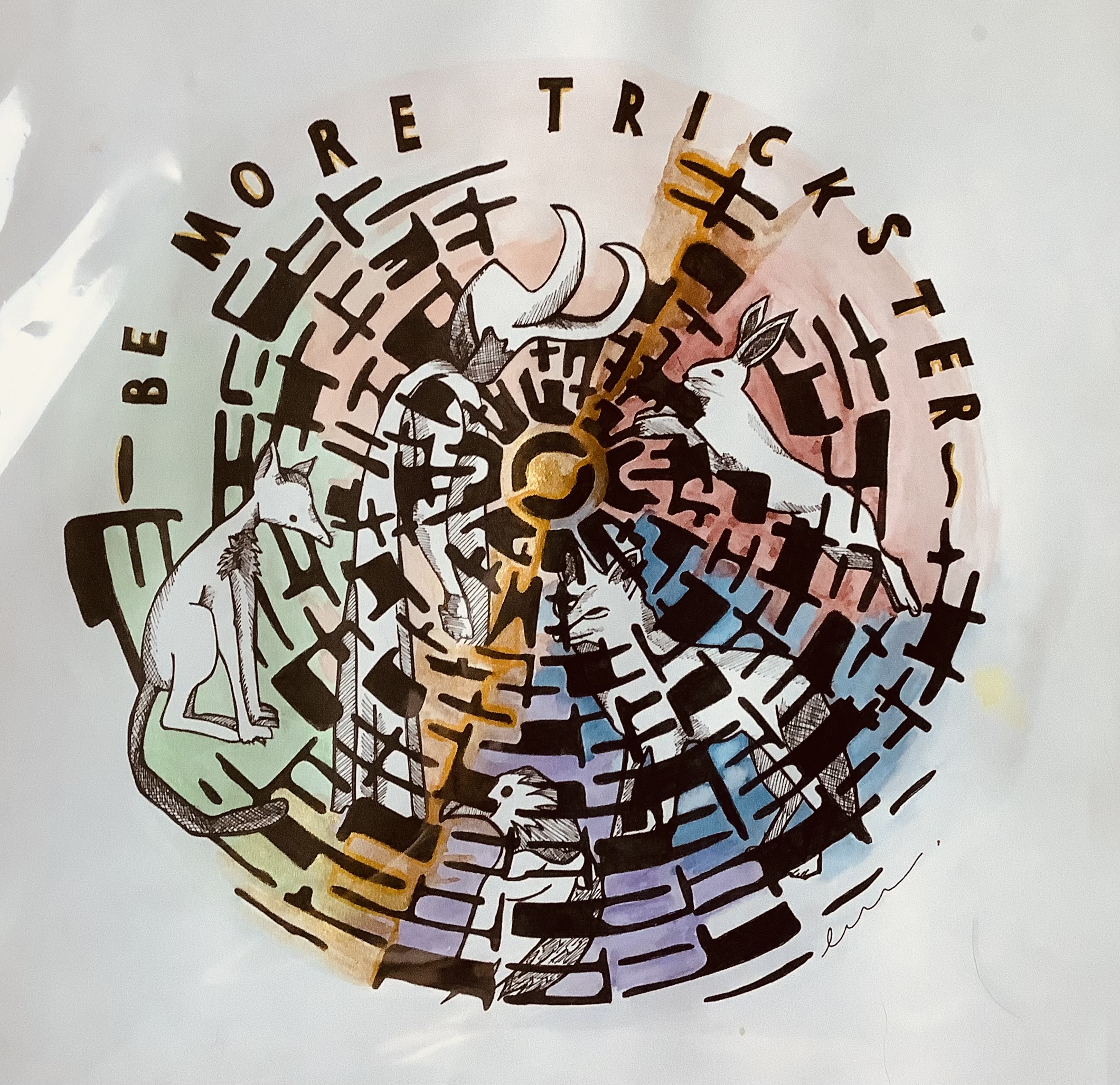
(The image was my leaving present from the wonderful Emma Richardson.) 

Towards an Entangled Ecclesiology

Following on from the post on Hopium which seemed to get a lot of traction I wanted to revisit and update the series of posts I did on rethinking church nearly 20 years ago as so much of theology has shifted.
The church, as we have inherited it, is a curious organism. We gather, we sing, we listen, we disperse. But beneath the surface, a tension still simmers when not masked hopeium.  A innate sense that the forms and definitions we cling to are no longer fit for the world we inhabit. As I wrote years ago, western Christianity’s subcultural weakness is not simply a matter of style, but of substance—a deep-rooted commitment to evolutionary tweaks, wrapped up in the idea of progress and an unconscious bias shaped by capitalism. So revolutionary re-imaginings are not given the space needed for real change. We are, perhaps, rearranging the furniture in a house whose foundations are already crumbling.
We have mistaken the kingdom for the church, and in doing so, we have shrunk the wild, inclusive, boundary-breaking movement of Jesus into something manageable, measurable, and ultimately, exclusive. The “mustard seed” has grown, yes, but what has taken root in its branches is not always shelter for the world’s birds, but often a haven for scavengers. The vultures of our own dualisms, our own need for security, our own reluctance to let go of the white make sky god reside in our branches and we welcome them both knowingly and unknowingly.

Our inherited dualisms—sacred/secular, worship/life, activity/being—have split us down the middle. We “worship” in buildings, but not in workplaces or wild places. We “pray” at set times, but not in the ongoing, messy encounters of everyday life. The emerging church, for all its creativity, often risks being a new style in an old paradigm—mission-flavoured rather than mission-shaped, to borrow George Lings’ phrase.
What if, instead, we took seriously the call to a holistic, post-dualist faith? What if, as eco-theologians remind us, the whole earth is full of God’s glory—not just our sanctuaries, but the soil, the rivers, the market stalls, the digital commons? What if, as Donna Haraway suggests, we are and always were already entangled—human and non-human, sacred and profane, church and world—in a web of becoming-with?

Let’s risk a new definition: Church is not an event, nor a building, nor a set of beliefs. It is a way of being and living—a series of chaotic but intentional encounters with God, with one another, and with the world. It is a porous, processual, ever-unfinished community, founded on the holistic teaching (and wild example) of Christ.
This kind of church is less about “services” and more about service; less about “worship” as a genre, more about worship as a posture of life. It is a community where everyone’s gifts—however secular or sacred they may seem—are welcomed, reflected upon, and woven into the shared story. It is a space where buying a fairtrade banana, tending a garden, or protesting for climate justice can be as much worship as singing a hymn, if done in love and for the flourishing of the other.

Donna Haraway’s call to “stay with the trouble” is deeply resonant here. Church is not about escaping the world’s mess, but about inhabiting it more deeply, more compassionately, more creatively. We are, as Haraway puts it, “companion species”—not just with each other, but with the more-than-human world. Church, then, is an entangled, ecological community: a place where we learn to be human together, in kinship with all creation.
Eco-theology reminds us that the redemption of all things is not a distant hope, but a present calling. The church is not a bunker against the world, but a compost heap—messy, generative, full of potential for new life. Our worship is not just liturgy, but liturgy lived: in acts of justice, care for the earth, radical hospitality, and the ongoing work of reconciliation.

So what might this look like in practice? Imagine a group of people—some committed, some curious—gathering, walking, sharing meals, tending gardens, reflecting together, acting together, welcoming the stranger, making space for lament and joy. Leadership is facilitative, not hierarchical. The process is open-ended, responsive to the Spirit, and always in conversation with the wider world. An invitation not a blueprint. As with all living things, church must be allowed to grow, adapt, and sometimes die, so that new life can emerge. We need the courage not to simply shift to new wineskins but a paradigm shift to wine bottles, such is the change demanded by the context 20 years on from when I first wrote.

We are living in a time of ecological crisis, social fragmentation, and spiritual longing. The old paradigms are failing us, and the world is groaning for communities of hope, justice, and deep belonging. The church, if it is to have a future, must be re-formed—not just in style, but in substance; not just in structure, but in spirit. (I’ll write some more on this after reflecting on Alasdair Macintyres death and revisiting his approach to virtue ethics)
But for now Let us, stay with the trouble. Let us risk the chaos of true community. Let us become, together, the community the world needs—entangled, embodied, and ever unfinished.

Building velocity

From SpaceX via Unsplash

Today I spotted Apprentice to Jesus, which was initiated by the wonderful Cannon Chris Neal. Chris was an amazing human, who had a huge impact on my thinking and ministry, not least because he coined the phrase “gravitational pull” in relation to pioneering in the institution. He would talk about the gravitational pull of inherited church as a double wrapped paradigm. There’s the culture/tradition that has been placed around the original (dissenting)idea as one layer ie the way we do things around here. Then the second structural layer of leadership hierarchy etc. Chris used to say pioneer projects need enough velocity to break that gravitational pull. Like a rocket needs the boost to break gravity and head towards the moon until the moon starts to pull it forward. I hope I will always have the courage to ride with the Holy Spirit or hang on to her coattails towards the new. However I wanted to reflect on the years since Chris’ passing some of the lessons that I have learnt that may help us reach the velocity needed.

Theres five ways I have identified so far to help create the velocity needed to break the gravitational pull. The first is the heretical imperative (and I’ve played with idea countless times across this blog) but today’s orthodoxy is yesterday’s heresy and a way into this is to embrace the pioneers on the edge and those pioneering beyond the boundaries. In Cumbria we have been gifted with some amazing pioneers on the margins following the Holy Spirit into new places as they reach new people and discovering new ways of thinking and theological insight as they go. This is the gift of the 3rd space fXs.
The second is the need for Authority dissenters (those in power in the system) to work with and release the Pathfinding Dissenters. Like the rocket needs the tower at the point of lift off and the people back at base (think Apollo 13 With images of the people behind the screens) helping the rocket break out we need the space and and support to get going, keep going and break out. It’s even better if you can launch several rockets from different spaces at the same time or spot those that may have already launched.

So the third is to network pioneers who are following the spirit into new things as the old system is dying. This network is vital in building the resilience needed, as things get tougher and the pioneers travel further out. But we need to watch this (see previous post). However through the network and community created pioneers can build the resilience needed to get through the ceiling whilst the old is dying and dream together of new ways. Connected to this is my fourth area which I think is something about scale and momentum, telling the stories of these pioneers and realising this isn’t some random one off but taps into the tradition of new life, of seeds dying, new wine skins that is happening all around us if we only have the eyes to see.

Lastly we need to recover our dissenting traditions, recover that history, and find stories from the tradition that fuels and connect the current pathfinders with the pathfinders of old. And here I don’t just mean those early saints or desert fathers and mothers, but more recent pathfinders in the tradition, and every tradition has them, for some it’s those dissenters that were part founding story like Wesley in Methodist, for others it’s pioneers who were misunderstood at the time, like Dorothy Day, Guteriezz, Punton or Rawnsley. Knowing our founding stories and finding those who have pioneered locally in the past is rocket fuel.

And as helpful (or not) as these reflections maybe as Chris would always remind us it does come back to being an apprentice of the master Jesus the pathfinder and perfector of our faith.

Missional spirituality and finding your tribe

For many pioneers it’s lonely, hard and the gift of not fitting is the gift that you often want to give back. Many people I know are questioning where they fit and how to connect. As old systems die and new ideas emerge those with the gift of not fitting can connect and in most cases this creates a resilient movement for system change. (System change theory)

Over the past few decades we have seen this in church, the old system and institution is in its death throws, pioneers connections made us think that the new system can emerge from these connections. We saw some possibilities emerge with things like mission shaped church and FX that encouraged us to think it maybe just around the corner. Social media and networks helped many of those early emerging church pioneers find each other and in doing so we started to find our tribe. Many of the tribe were also already in the institution and the possibility of change led others to connect.

However many people I know with a deep sense of missional spirituality that emerged from practice on the ground are wondering if this is still their tribe and sensing something is not quite right.

I think two things are happening. Firstly because the church is such a strongly double wrapped paradigm it is much harder for those connectioned individuals to get the change needed to help the new system emerge. As the church embraced those from the edge that double wrapped paradigm bought control and sanitised the re-wilding. I’ve written elsewhere for example that FX gave the institution the ability to control the emerging church.
Secondly the rise of social media meant that the network grew fast and this caused it to be noticed. So then as institution got involved often with good intentions it meant in that growth the network accelerated but it also dissipated which created perfect conditions for the double wrapped paradigm of systems and hierarchy to pull back from real change.

But I think the good news is that the missional spirituality embedded within pioneers always pulls us back to wild practice and hope of change, and this is why so many are struggling to find our tribe within this new set up. But perhaps we need to think differently about systems change in the institution and our place in it because the institution has still not admitted to itself honestly where it’s at.

So instead of looking for a particular tribe and networking for change we need to recover and lean into our missional spirituality that bought us this far and recognise that there is a deep ecosystem at work that finds a way across tribal boundaries, and beyond institutional systems and connects. This will mean for some staying connected with institution and edge, for others leaving the institution again, but let’s foster that underground ecosystem that nurtures and sustains and that you only find as you embed yourself in your community and find others doing the same.

Play and Dissent In complex systems

On the 8th Feb we are having a taster day for the certificate in pioneer mission that will be starting in September as part of the Northern Pioneer Centre. The day the Pastoral Statement landed I was planning a session for the taster event on the stories pioneers find themselves in and using Arbuckles notions of dissent and lament. Particularly how pioneers led by Jesus find themselves so often on the edge and how they need to value the experiences of seeing the beloved manifested in those places as resource for hope and a call to dissent. “There can be no constructive change at all, even in church, unless there is some form of dissent. By dissent I mean simply the proposing of alternatives, and a system that is not continuously examining alternatives is not likely to evolve creatively.”
Arbuckle Refounding the Church
I guess this is where the church (as denominations) often gets caught, as it fails to understand system complexity. This system complexity helps make spaces that try to examine, try to propose alternatives, and even try’s to listen (E.g. shared conversations) but is placed within an institution (and fixed false orthodoxy paradigm rooted in the enlightenment) that favours reductionism that can never compete with the complexities of following the way of love in the person Jesus. So dissent really matters, because orthodoxy that exists in a vacuum is not truth, and the Jesus way demonstrates orthopraxis that love is a way of dissent toward shalom.

At the same time my FB memory popped up with “ Whisper, somewhere beyond usefulness is a land where play reigns.” For May 29-31st we are following the Taster day with a Pioneer Fiesta(all ages welcome). In the heart of the Lakes there will be camping (with the opportunity to come early if you want a holiday) or book a B&B, and join in the stories, food and play. We are playing with different voices animating Mark 4 going to the other side of the lake. The word animating is used deliberately as there will be playful experiments including a messy take, an outdoors take, an artists take, an entrepreneurs take, a priests take, an inclusive take etc all around Mark 4. We are also Literally taking a paddle steamer to the other side of the lake and having a band and party on board. If you want to find out more email godforallevents@carlislediocese.org.uk.

At the moment I know I am called to be on the inside edge of this system and my commitment to the bride of Christ keeps me hanging there. At times I find playing with words is one of the few ways I can cope when the institution gets too much so here is an offering Of hopeful playful dissent.

Love is judged unworthy and tears of sadness grow.
Acidic edicts, camouflaged in priesty garments,
close doors to grace filled embraces.
Love sits outside with the masses
Bewildered at processes so reduced so disconnected
and so this holy water from different wells will flow.